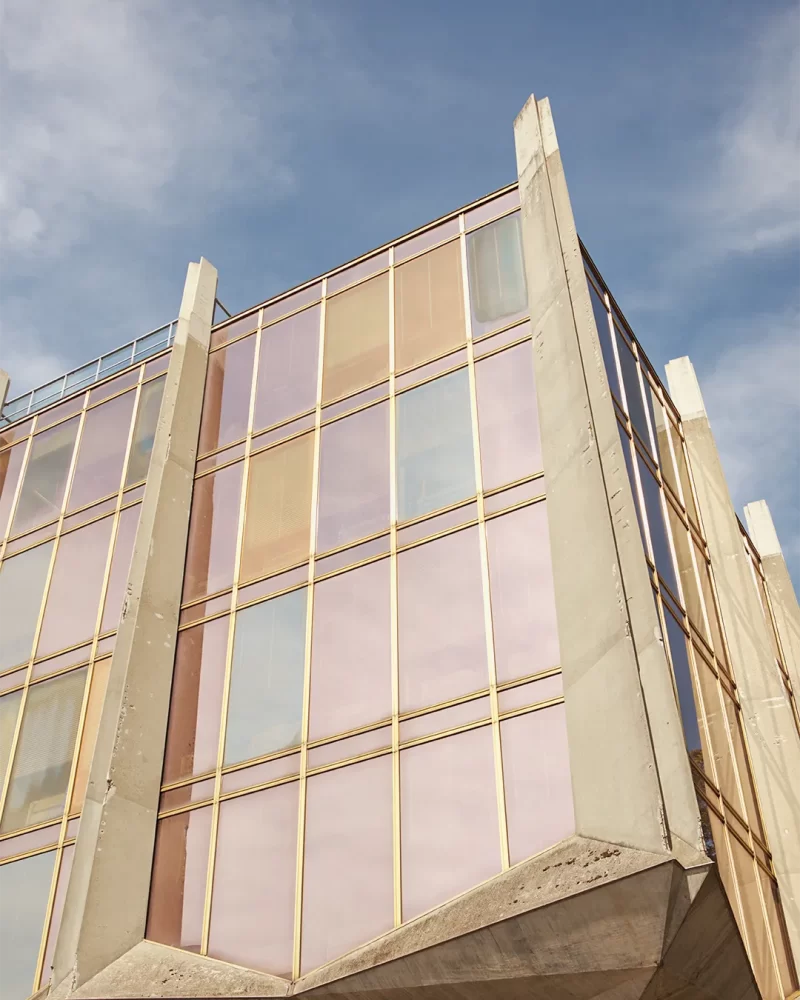
Saurer Tower, Saurerhochhaus, Georges-Pierre Dubois, Arbon, 1958-1960, Swiss Brutalism, © Karin Bürki/Heartbrut. Explore more on Heartbrut.com

Saurer Tower

Arbon’s answer to Le Corbusier’s Unité d’habitation is the result of a happy meeting of two brothers, social capital and an era characterised by economic optimism, reinvention and social change.
Picture of Words & images: Karin Bürki

Words & images: Karin Bürki

In postwar Switzerland, architects were tasked with finding answers to radical social upheaval and unprecedented economic growth. The Saurer high-rise, built in Arbon in 1960, set an early exclamation mark. The 13-storey concrete tower on stilts introduced maisonette flats for working-class families to the canton of Thurgau.

First, some context: Arbon is a historic town on the southern shore of Lake Constance, located between Constance and Bregenz. During the 20th century, the town became synonymous with Saurer, a world-leading manufacturer of trucks, buses, military vehicles and textile machinery. The company reached its peak during the postwar boom years, employing over 5,000 people. Faced with a rapid influx of workers, Arbon was bursting at the seams, and in desperate need of new and affordable housing.

Albert Dubois, Saurer’s managing director at the time, came up with a brilliant solution. He commissioned his architect brother to design a striking building to house 200 ‘Saurer families’. His motives were not entirely altruistic, though. The ‘Saurer Tower’ would cement the company’s status as a socially responsible employer, but also serve as excellent PR, positioning Saurer as a forward-looking global player. Georges-Pierre was the perfect man for the job, having worked in Le Corbusier’s studio between 1937 and 1940. He seized the opportunity to build his own version of the Unité d’habitation in Marseille – Corbusier’s brutalist masterpiece from 1952, which rewrote the rules of housing estate architecture.

Dubois scaled down and optimised the Unité design to meet local needs and regulations, as well as Saurer’s higher-quality standards. His original vision was for a twin-tower complex, but this plan was shelved due to budgetary reasons. The final tower contains 95 flats. These are split into single-storey flats on the south side and stacked maisonettes on the north side. These are accessed via open walkways. All the living rooms and some of the bedrooms face west and are located either on the lower or the upper floor of each flat. The maisonettes afford sweeping views of Lake Constance and the bucolic Thurgovian hinterland. Though the rooftop lacks the swimming pool of the Marseille original, it offers a very Swiss institution – a communal laundry room. It vaguely resembles the command bridge of an ocean liner, perhaps a nod to Le Corbusier’s obsession with everything steamship. It overlooks nine, neatly lined-up Stewi rotary clothes dryers.
Having turned 60 in 2020, the Saurer Tower is in great shape. Flanked by carefully manicured topiary and surrounded by generous green spaces and a communal park, the estate exudes the kind of pristine picture-postcard perfection only Switzerland manages to produce. Over the years, the mix of tenants has become more diverse. Today, singles and couples far outnumber Saurer employees and families with children. Though the floors no longer compete against each other in football matches, the strong community spirit remains intact. In 2009, a thorough revamp brought the concrete, infrastructure and kitchens up to date. The number of rooms in the maisonettes is gradually being reduced to allow for more spacious living. This young-at-heart concrete beauty is clearly enjoying its whiskey years. Here’s to you!